Showing posts with label classics. Show all posts

Saturday, June 18, 2011

Introduction to Best of Japanese Cinema - Part 1 (Kurosawa & Mifune)

The Magnum Opus Of Japanese Cinema : Seven Samurai 
Cinema in Japan has lot in common to Indian Cinema. Like India they have big industry producing third highest number of films annually after India and USA. But like India best work is mostly outside that factory type Studios turning out products each year, as a result true Cinema and great directors and actors you can count on fingers. My focus is on artistic beauty so i will cover later Category of heavy weights.

once again like India, Japan also had it's golden age of cinema in 50's. In india it was time of greats directors like
Bimal Roy,  Guru Dutt, Satyajeet ray, Ritwik Ghatak, Mrinal Sen, Chetan Anand and Buddhadeb Dasgupta 
Similarly Japan also had it's most influential Directors working together in 50's
Akira Kurosawa (Greatest)
, Yasujirō Ozu, Kenji Mizoguchi, Ishirō Honda, Teinosuke Kinugasa, Hiroshi Inagaki, Masaki Kobayashi
Since movies are like poetry Which requires efforts at three stages for final accomplishment. these are
having an idea about what to show putting together the ideas into rough narrative  finding the best expressions for narrative. Thus without doubt director is central figure to movie like a poet to poem
but here actors are to movie, what language is to poem and just like best of poets are incomplete without language, it is not possible to have masterpieces with efforts of directors alone. so indeed 50's were also the time of greatest japanese actors

Legendry Toshirō Mifune, Great Takashi Shimura, Other notable additions -  Yoshio Tsuchiya,
Tatsuya Nakadai, ken watanbe (later period)

Friday, June 17, 2011

GUIDE

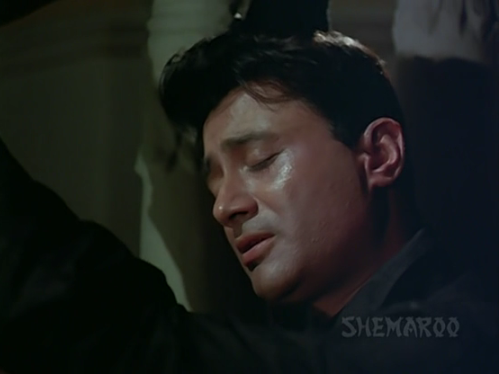
 This essay i am citing from Philip LutgendorfGUIDE is considered as one of the best Hindi film of all times and it's my personal favorite too. Citing this essay, i am also providing the preview to my favorite webpage on Indian cinema.
                        GUIDE (1965), Hindi, color, 170 minutes.
                                    Directed by Vijay Anand. Music by S. D. Burman.
The Anand brothers ambitious adaptation of R. K. Narayan's novel is a lush allegory comprising paradoxically-paired themes of, on the one hand, nation-building, modernization, and social reform, and, on the other, world-renunciation and spiritual self-realization -- all enduring preoccupations of contemporary Indian culture. 
Dev Anand stars as the effervescent Raju, a fast-talking, self-promoting tourist guide in the Rajasthani city of Udaipur, who in time becomes the successful promoter of his dancing-girl mistress, and ultimately (through his accidental transformation into a "mahatma" worshiped by illiterate villagers) of himself -- or rather (in deference to the filmmakers' neo-Vedantic ideology) of the unitary, absolute Self.

Thursday, June 16, 2011

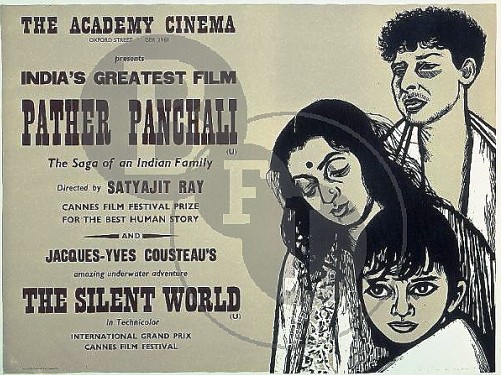
Pather Panchali


Although this the latest movie i watched recently, but it left me amazed with it's sheer depth and beauty of narrative. It was as if you sketch verses of Rabindra Nath Tagore over canvas of Premchand's prose and then add the colors from Jean Paul Sartre existentialism. 


Rating - 5/5


Review :


Pather Panchali feels as real as life itself.It is a narrative of life par excellence as the protagonist of movie is no character but rather life itself which i wonder "what cinema, at its best, is capable of achieving".
It's a quiet, simple tale, centering on the life of a small family living in a rural village in Bengal. The father, Harihar (Kanu Bannerjee), is a priest and poet who cares more about his writing and spiritual welfare than obtaining wages he is owed. The mother, Sarbojaya (Karuna Bannerjee), worries that her husband's financial laxity will leave her without enough food for her two children, daughter Durga (Uma Das Gupta) and son Apu (Subir Bannerjee). 

Satyajit Ray
Harihar's family often lives on the edge of poverty, coping with the unkind taunts of their neighbors, the burden of caring for an aging aunt (Chunibala Devi), and the terrible aftermath of a natural catastrophe.

PYAASA

 This essay i am citing from Prof.Corey Creekmur. I will add my own notes soon as well. Pyaasa is considered as one of the best Hindi film so far and it's my personal favourite too as i have watched it at least 5 times so far but still have craving for more. Citing this essay, i am also providing the preview to my favorite webpage on Indian cinema.
One of Greatest Indian Films
PYAASA
(1957), Hindi, 139 minutes
Directed by Guru Dutt. Music: S. D. Burman Lyrics: Sahir Ludhianvi
Playback Singers: Geeta Dutt, Mohammed Rafi, Hemant Kumar (aka Hemanta Kumar Mukherjee), Cinematography: V. K. Murthy
(notes by Corey Creekmur, Department of Cinema and Comparative Literature, University of Iowa)


Rating - 4.5/5
Review
Pyaasa ("The Thirster") represents a high point in Indian cinema that, along with Mother India (also 1957) and major films by Raj Kapoor and Bimal Roy, confirms the 1950s as Hindi cinema's golden age.
In his seventh film as a director, Guru Dutt -- taking a role originally intended for Dilip Kumar, who rejected it as too similar to his 1955 Devdas -- established his definitive screen personification as the anguished poet Vijay, whose artistic efforts are only appreciated by his loyal mother, his early but eventually materialistic college girlfriend Meena (Mala Sinha), his comical pal the masseuse Abdul Sattar (Johnny Walker), and, most profoundly, the young prostitute Gulab (Waheeda Rehman, who had premiered in Guru Dutt's production C.I.D. the previous year). Vijay's sensitivity and the world's indifference are established in a prologue depicting Vijay composing a poem in nature as he watches a bee flitting from flower to flower; suddenly, the bee is crushed by a passing stranger, the first in a series of innocents trodden under cruel heels throughout the film. Thrown out of his home by his coarse brothers, who have sold his poems as scrap paper, Vijay encounters Gulab singing one of the poems (Ho lakh musibat rasten men) she has learned from the papers purchased from the junk dealer. Flirting with Vijay as a potential customer, but rejecting him when he is found to be penniless,